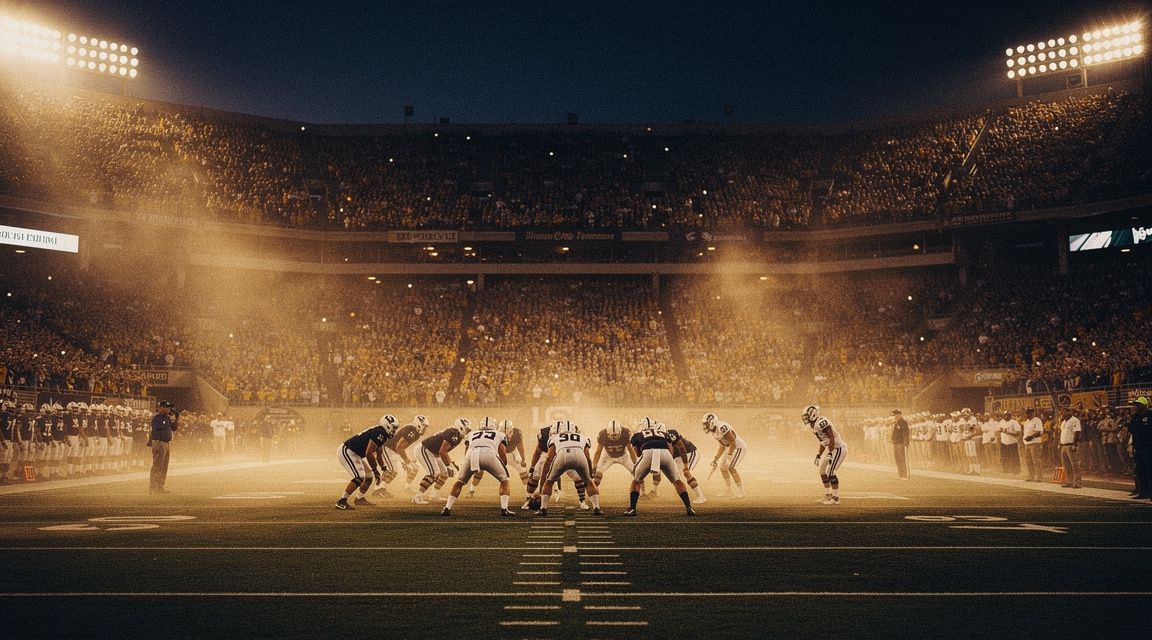
The biggest chaos scenario this season isn't a random upset. It's one of Georgia, Alabama, Oregon or Ohio State finishing 8–4. Those teams still look too big to fail, but the floor everybody assumes they have isn't sitting above eight wins anymore.
I understand the usual read. These are four teams that have been really good for a long time, and their recent regular-season records explain why people treat an 8–4 season like a structural impossibility. Georgia last lost four regular-season games in 2016. Alabama hasn't done it since 2007. Oregon hasn't since 2017. Ohio State hasn't since 2011.
That history matters. It just doesn't protect the next injury, the next bad bounce or the next one-possession loss.
The floor moved because the depth margin moved
The modern roster changes the task before the game even starts. A team can still be good and lose the player who holds a position together. It can still play well and lose several close games. I don't need one of these programs to become a disaster. I need injury misfortune and the wrong side of a few one-possession games.
“This is a new world. The depth situation has radically changed.”— Josh Pate
This is a new world. The depth situation has radically changed.[/PULLQUOTE]
That isn't a prediction that Georgia, Alabama, Oregon or Ohio State will go 8–4. It means the old assumption that the floor is safely above eight wins has stopped matching the conditions around the sport. Georgia can go 8–4 in this day and age. Oregon can go 8–4, or even 7–5, without being a bad team.
The schedule can turn a good team into a wounded one
Texas gives me the cleanest example of how fast this can happen. I agree Texas is a favorite to win the SEC and make the playoff. But if Texas loses to Ohio State in week two, then loses at Tennessee a couple of weeks later, it reaches the Oklahoma game with two losses and its back against the wall.
That isn't the same team entering Red River. The opponent gets a different task. Oklahoma isn't facing a favorite with room to recover. It's facing a wounded team that knows one more loss could end its playoff path with three weeks still left until Halloween. A pretty good team probably loses to Ohio State. A pretty good team can get rattled on the road at Neyland Stadium.
Chaos spreads when the favorites stop separating
The same pressure applies to the Big Ten. I agree with the working theory that Ohio State sits in a clear top tier while the SEC is muddier. But Ohio State plays Oregon, Indiana, USC and Michigan. The top teams keep running into each other, and each result can take a clean 10–2 picture and turn it into three-loss carnage.
The condition is simple: the top tier has to beat itself up and then fail to handle the teams below it. If that happens, the Big Ten looks less like the orderly league people expect and more like the SEC they think will cannibalize itself.
Houston at Texas Tech in week three is another test of that separation. Texas Tech is the clear favorite to win the Big 12, while Houston sits behind the teams from Utah in the odds market. If Houston wins in Lubbock without a minus-four turnover fluke and looks every bit as good as Texas Tech, the conference opens wide. BYU, Utah, Houston, Kansas State, Texas Tech, Arizona and Arizona State can all enter the picture.
That is the mechanism. A result that changes the quality read on one team changes the whole race around it.
I don't expect all of this to happen. I don't expect any of those four giants to go 8–4. But that outcome is possible because the sport now punishes thin depth and close-game mistakes much faster than the old reputations can cover. The floor isn't above eight wins anymore, and one injury plus a few bad fourth quarters can prove it.
Articles are drafted from Josh Pate's College Football Show under the site's editorial standards and monitored by the editorial team — corrections are timestamped, never silent.
CONTINUED FROM THE NOTEBOOK
Ole Miss 2026: Chambliss sets the ceiling, the schedule sets the floor, and two roster gaps decide the playoff bubble
Ole Miss returns the SEC's best quarterback and a loaded backfield, but replacing five of its top six pass catchers and its top pass rusher makes 9-3 the likeliest answer.
ANALYSISProduced with Pate State AI · reviewed by The Pate State editorial teamStandards 📝 The Sit-DownTS
The Pate State StaffAUG 19, 2026
Ole Miss is the most volatile team among the top 15 because the quarterback gives it a playoff ceiling while the schedule and two unproven replacement jobs give it a serious floor. I have the Rebels most likely at 9-3, which puts them on the playoff bubble rather than safely inside it.
I start with Trinidad Chambliss. “Trinidad Chambliss is the best quarterback to me in the SEC. You could make the argument coming into the season, best quarterback in the country.” He had eight games with 300-plus yards, five games with 50-plus rushing yards, and only three interceptions across 13 starts last season. That production gives Ole Miss a clean answer when a game turns into a quarterback contest.
The question is whether year two gets better or gets harder. The league has a full season of tape on Chambliss, and Ole Miss has a new offensive coordinator. The offense still has Quinshon Judkins, who had more than 300 carries last season, so defenses can't sell out against the quarterback. Chambliss and Judkins force a defense to cover the full width and length of the field. That's the matchup that sets the ceiling.
The offense has one hard replacement job. Ole Miss lost five of its top six pass catchers and returns only one player with more than 200 receiving yards, Deuce Alexander. I see potential in Jontay Cook, D'Eriq King, and Caleb Odom, but I don't see a proven second target I can write down for 650 or 700 yards. Deuce Alexander may need to move from 684 yards to roughly twice that because the role has to grow before the production can.
I credit the defense before I question it. This was a top-40 defense last year, Will Echols is back, Cam Franklin is back, Suntarine Perkins is back, and all five projected defensive backs are upperclassmen. The safety room got stronger through the portal, and Kaitlyn Crawford gives Ole Miss a top-end corner duo. That experience can keep the defense from carrying the kind of transition burden people expect.
Pass rush is the exception. Principle Yuma M'balien led the team with nine sacks, nearly twice as many as the next closest player. No one else had more than five. Cam Franklin doesn't need to replace nine sacks one-for-one, but he does need to become a pass rusher opponents name early in the week. If he doesn't, Ole Miss can have experienced coverage behind a front that can't finish drives.
Then comes the schedule. Last year's schedule was the third easiest in the SEC. This year's is the fifth toughest in the FBS. Louisville in Nashville comes before the LSU game, and then the middle of the schedule brings Florida, Vanderbilt, Texas, Auburn, Georgia, and Oklahoma.
That Louisville game is a real trigger point. If Ole Miss handles it, Chambliss gets room to operate inside a season that can build momentum. If it doesn't, the schedule starts squeezing the roster gaps immediately.
I can make the 12-0 case. I can also make the basement case. With injuries, a step back from Judkins, and no pass-rush replacement, 5-7 or 6-6 is in the cards. That's the bottom floor, not the expectation.
The most likely answer is 9-3, and that record lands Ole Miss on the playoff bubble.
“what's most likely with Old Miss, according to the model here, is a 9 and 3 season, which puts them on the playoff bubble.”— Josh Pate
“what's most likely with Old Miss, according to the model here, is a 9 and 3 season, which puts them on the playoff bubble.” One bounce can make it 10-2 or 8-4. I believe a three-loss team can make the playoff for the first time this year, and Ole Miss is one of the teams that could occupy that spot.
Ole Miss is a playoff contender because Chambliss and Judkins give the offense answers against every kind of defense, but 9-3 is the proper forecast until Deuce Alexander replaces lost receiving production and Cam Franklin replaces enough of the pass rush. Watch Louisville first. That game will tell me whether the Rebels' ceiling has room to survive the schedule.