Oklahoma at No. 14: John Mateer's ceiling, the tight end fix, and the run game that decides the season
The Sooners can justify a top-14 preseason ranking without becoming a dominant rushing team. They cannot justify it if 118.5 rushing yards per game was the start of a trend instead of the problem Brent Venables hired new help to solve.
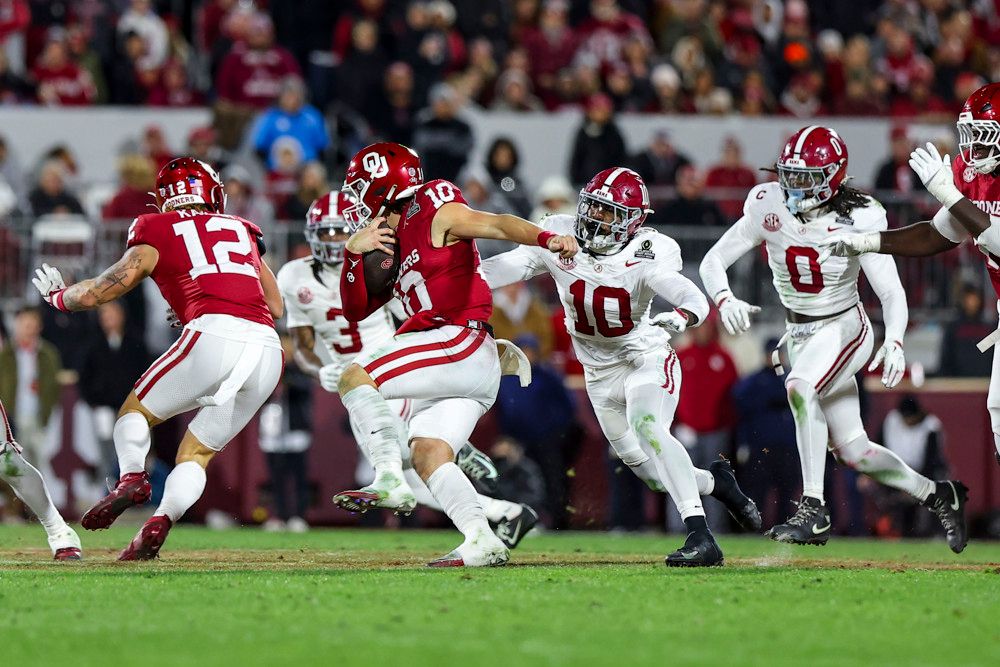 Photo: Chad Hamilton/Icon Sportswire
Rushing yards per game in 2025
SEC rushing rank
2025 record despite the run-game problem
Oklahoma's No. 14 ranking rests on one repair job. The Sooners need the run game to improve enough that John Mateer stops having to create every answer himself.
That is the ceiling, floor, and most likely outcome in one sentence. If the new tight end room can make 12 personnel a real run threat, Mateer gets cleaner downs and Oklahoma belongs in the national conversation. If those sets produce bodies without movement, defenses can keep their comfort, the quarterback sees more pressure, and No. 14 becomes a preseason number with no sturdy football underneath it.
Oklahoma went 10-3 in 2025, but averaged 118.5 rushing yards per game. That ranked 13th in the SEC. The Sooners do not need to turn into a 250-yard rushing team. They need to stop making the offense ask Mateer to win every hard down.
“I don't think I have to explain too much more thoroughly that if John Mateer's the number three quarterback in this league, Oklahoma's a playoff team this year.”
Josh PateJohn Mateer has to get easier snaps
The task comes before the quarterback. Oklahoma needs to create manageable downs before Mateer has to solve the game himself.
Mateer dealt with a thumb injury, then struggled with turnovers after returning. That matters because turnovers rarely arrive in a vacuum. A run game that fails to gain enough early can turn second down into a problem. A second-down problem can turn third down into a pass rush audition. That is how a quarterback's margin for error gets squeezed until every drive feels like a rescue mission.
Mateer does not need to become a different player for Oklahoma to reach its ceiling. He needs fewer snaps where the offense is behind schedule and the defense knows the throw is coming. A functioning rushing attack gives him that. It also keeps defenses from treating every spread formation as an invitation to attack him.
Josh Pate's playoff test is blunt: " I don't think I have to explain too much more thoroughly that if John Mateer's the number three quarterback in this league, Oklahoma's a playoff team this year."
That quote sets the ceiling, but it also sets the condition. Mateer can be the third-best quarterback in the league only if Oklahoma stops making him carry the offense through bad situations. The quarterback's ceiling is tied to the blocking task, not separated from it.
The honest counterpoint is that Oklahoma already has enough quarterback talent to make the offense dangerous without a great run game. That can carry a team through stretches. It is a poor plan for a full SEC season. The failure condition is plain: if the Sooners stay near 118.5 rushing yards per game, Mateer's turnover pressure stays high and the playoff path gets narrow.
The tight end room is the hinge
Venables spent the offseason rebuilding a room that had struggled as a run-blocking group for three years. Jason Witten now coaches the tight ends. Hayden Hansen, Jack Van Dorselaer and Rocky Beers arrived through the transfer portal.
Those are useful changes. They are not proof of a fixed position.
The reported plan is more 12 personnel, with two tight ends on the field. The football reason is sound. Two tight ends can give Oklahoma a heavier surface, help the offense run the ball, and force a defense to decide whether it wants to add bodies to the box.
That only works if the tight ends create movement at the point of attack. The scheme term is 12 personnel. The consequence is simple. If the Sooners can block from it, defenses have to respect the run and Mateer gets better throwing conditions. If they cannot, the grouping becomes decoration and the defense gets to play the same math it played last year.
The first useful test is a defense that can keep six defenders in the box and still handle Oklahoma's two-tight-end sets. If the Sooners force extra bodies into the box, the ranking has a football reason behind it. If they do not, the new personnel has changed the brochure more than the offense.
Credit belongs to Oklahoma for attacking the actual weakness instead of pretending the old version was close. Credit also belongs to the defenses that will challenge the plan. They will not add a defender just because a tight end walked onto the field. Oklahoma has to make them pay for staying light.
The counterpoint is coaching. Witten can improve technique and details even before the room becomes a finished product. Three additions give the staff more options than it had. But better instruction and more bodies still have to show up as movement on first down. The failure condition is a tight end group that catches the eye in formation and loses the rep at the line.
Oklahoma's floor is a familiar offensive problem
The floor is not a collapse. The floor is another season where the defense has to rescue an offense that cannot stay on schedule.
Oklahoma's run game can improve modestly and still leave Mateer exposed. A few more successful carries do not matter much if the offense remains predictable from heavier sets. The defense will stay comfortable, pressure will arrive on obvious passing downs, and the quarterback will again be asked to create the answer after the offense created the problem.
That is why the ranking puts the run game under more pressure than the number beside Oklahoma's name suggests. Oklahoma is the sixth-highest SEC team in the preseason list. A top-14 ranking places the Sooners in a real national tier, but it leaves little room for an ordinary offense in a deep conference.
The defense is expected to be sound again. A better rushing attack would keep that defense from having to rescue every close game. That connection matters more than a raw yardage target. Oklahoma does not need a flashy run game. It needs one that keeps defenses honest, produces manageable downs and reduces the number of times Mateer has to play hero.
The counterpoint is the 10-3 record. Oklahoma already showed it can win at a high level. That record gives the Sooners a stronger case than a purely theoretical preseason team. But the 2025 rushing average identifies the part of that team most likely to decide whether the next step is real.
If the tight ends lose at the point of attack, the floor arrives quickly. Defenses stay lighter, Mateer sees more pressure, and the offense returns to the same burden. The defense may keep Oklahoma competitive. It cannot make a bad run-game plan good.
The likely outcome sits between repair and breakout
The most likely outcome is a meaningful run-game improvement that makes Oklahoma better without turning the Sooners into a weekly rushing machine.
That is enough if the improvement changes the defensive response. Oklahoma can justify No. 14 by moving from a poor rushing profile to a functional one. The number matters less than what it does to the box. If 12 personnel forces defenses to respect the run, Mateer gets cleaner throws and fewer desperate third downs. If the run game improves only on paper while defenses remain comfortable, the offense has not really moved.
Mateer's ceiling is a playoff-level season when the surrounding structure lets him play on time. His floor is another turnover-stressed season in which too many drives depend on difficult throws. The most likely version is a quarterback who looks far better when Oklahoma wins early downs and far more ordinary when the tight end room cannot sustain blocks.
Quickly, the supporting pieces are clear. Witten gives the room a new teacher. Hansen, Van Dorselaer and Beers give it new personnel. Venables has a defense expected to be sound again. Oklahoma's 10-3 finish provides the baseline. None of those facts settle the run game. The point of the changes is to make the offense less dependent on Mateer, and that answer will show up in the blocking.
The Georgia matchup already carries the kind of weight that exposes this issue. Josh Pate has said, "give me Oklahoma, Georgia. That one is written in pencil right now." A game like that will not be decided by the label on the personnel grouping. It will be decided by whether Oklahoma can run from it well enough to keep the defense honest and keep Mateer out of rescue-ball situations.
The Oklahoma verdict
Oklahoma is correctly ranked No. 14 if the tight end rebuild produces a functional run game. That is the case, and it is the condition.
The Sooners' most likely season is a better offense built around a better-supported Mateer, not a dominant rushing attack. The mechanism is 12 personnel creating movement, movement creating manageable downs, and manageable downs reducing the quarterback's turnover pressure. If the tight ends cannot win at the point of attack, the ranking has no football foundation.
Watch the first defense that keeps six in the box against Oklahoma's two-tight-end sets. If the Sooners force that defense to add help, No. 14 is real. If it does not, the season is asking Mateer to carry too much again.
The run game has to cash the ranking. Check the Oklahoma team page after that first real test and judge the season by the box count before the rushing total.
01 · The Open QuestionsQuestions to Be Answered
Can the rebuilt tight end room make 12 personnel a real run threat?
Jason Witten now coaches the position, while Hayden Hansen, Jack Van Dorselaer and Rocky Beers arrived through the transfer portal. Oklahoma's ranking depends on those additions producing movement at the point of attack, not simply more bodies in heavier formations. The first defense able to stay with six in the box will offer the clearest answer.
Will a better run game keep John Mateer out of rescue-ball situations?
Oklahoma averaged 118.5 rushing yards per game in 2025 and ranked 13th in the SEC despite going 10-3. If the offense wins early downs, Mateer gets cleaner throws and fewer desperate third downs. If it stays near that rushing profile, pressure and turnover stress can again narrow the playoff path.
Can Oklahoma run well enough against Georgia to force a defensive adjustment?
The Georgia matchup carries the kind of weight that exposes whether the repair is real. The game will not be decided by the 12-personnel label, but by whether Oklahoma can run from it well enough to keep the defense honest and keep Mateer from having to create every answer himself.
02 · The Watch ListWhat to Watch Next
Can Oklahoma make six in the box unsafe?
Watch the first defense that keeps six defenders in the box against Oklahoma's two-tight-end sets. The tell is whether the Sooners force that defense to add help.
Do the tight ends create movement at the point of attack?
The new grouping only works if Oklahoma can block from it. A tight end room that looks heavier in formation but loses reps at the line turns 12 personnel into decoration.
Does Mateer get manageable downs?
The article ties cleaner throwing conditions to a run game that wins early downs. Watch whether Oklahoma avoids obvious passing downs and the pressure that follows.
Is the rushing improvement changing the defense?
The rushing total matters less than the box count. Oklahoma can improve on paper without changing the offense if defenses remain comfortable staying light.