 Vanderbilt
Vanderbilt Chooses Blaze Berlowitz. Jared Curtis Can Still Change the Story
Clark Lea is opening 2026 with a fourth-year transfer instead of the highest-ranked recruit in program history. The first three games will show whether Vanderbilt bought early stability or delayed a decision it may have to make under pressure.
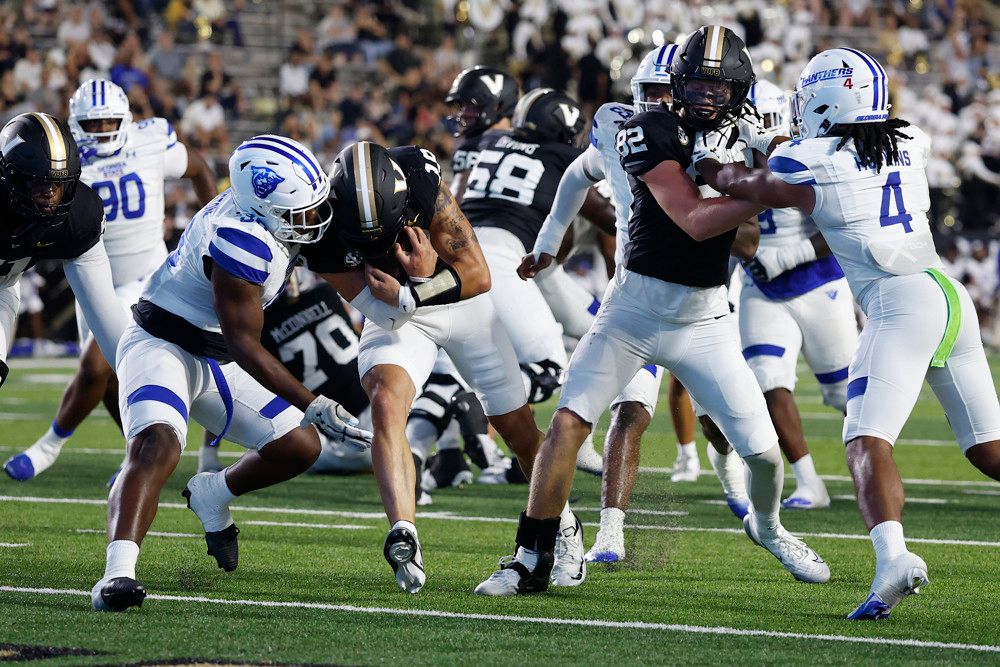 Photo: Matthew Maxey/Icon Sportswire
Games Berlowitz appeared in behind Diego Pavia
Berlowitz passes completed last season
Berlowitz passing output in that reserve sample
Vanderbilt is starting Blaze Berlowitz over Jared Curtis, and that choice says more about the next three months than the next three years. Berlowitz gives Clark Lea a fourth-year quarterback with some college experience. Curtis gives Vanderbilt the kind of long-term upside that can change a program. Lea is choosing the steadier opening move, even though the more talented option may be sitting one seat away.
Berlowitz is reported to have won the job after following Diego Pavia from New Mexico State. He appeared in six games as Pavia’s backup last season, completing 9 of 17 passes for 131 yards and one touchdown. That is a small sample, not a body of work that settles every question. It is enough to give the staff something Curtis does not have yet: snaps in Vanderbilt’s quarterback room and a season of seeing how the program operates on Saturdays.
That distinction matters most in September. A quarterback does not need to be spectacular to help a team get through an opener. He needs to get the offense lined up, make the protection call, deliver the ball on time and avoid turning a manageable down into a rescue mission. Berlowitz has at least been through the weekly routine of backing up a starting quarterback. Curtis has not played a college snap, at least none included in the available record.
“Vanderbilt is buying a known amount of experience, not certainty.”
From the storyVanderbilt opens Sept. 5 against Austin Peay, hosts Delaware after that and then faces NC State in Week 3. Those games give Berlowitz a short runway to make the decision look comfortable. They also give Curtis a defined place in the conversation. If Berlowitz moves the offense cleanly through those first games, the choice gains weight. If the passing game stalls or Vanderbilt keeps asking the quarterback to create difficult plays late in downs, Curtis will become more than an exciting backup. He will become the obvious name attached to every stalled drive.
Curtis arrived with a different kind of pressure already attached to him. He flipped from Georgia to Vanderbilt on National Signing Day in December after being ranked the No. 2 quarterback in the 2026 class. He is also the highest-ranked recruit in Vanderbilt history. That résumé explains the outside expectation, but it does not answer the question inside the building. Recruiting status can tell a staff what a player might become. It cannot tell the staff whether he is ready to handle the protection, pace and mistakes that come with starting now.
A five-star quarterback can change a program. A five-star freshman quarterback can also force a program to decide how much of that change it wants to demand immediately. Starting Curtis would have placed the entire opening month around his adjustment. Every missed read would have been part of his education. Every good throw would have raised the volume around the next one. Choosing Berlowitz lets Vanderbilt separate the team’s early results from Curtis’s development, at least for the moment.
That separation is useful for Lea, but it has a limit. Berlowitz is not replacing a player with a long record in this Vanderbilt offense. He is stepping into the first season in which the staff must find out what the team looks like without Pavia taking those quarterback snaps. The available numbers show Berlowitz had a reserve role behind Pavia, not that he has already proved he can run the offense over a full season. Vanderbilt is buying a known amount of experience, not certainty.
That is where the decision can turn on Lea. If Berlowitz is efficient, the staff can keep Curtis on his own pace and avoid rushing a freshman because the recruiting ranking demands it. Curtis can learn the offense, absorb the weekly preparation and wait for a role that is earned rather than handed to him by anticipation. For Vanderbilt, that would be the clean outcome. The veteran gives the team a stable start, while the prized freshman develops without having to carry the entire season’s meaning.
The other outcome arrives quietly. Berlowitz does not have to play badly for the pressure to build. He may simply fail to give Vanderbilt enough in the passing game. A quarterback who protects the ball but cannot keep drives alive creates a different kind of problem from one who throws interceptions. The defense spends more time on the field, the run game faces heavier boxes and third down becomes a regular repair job. At that point, Curtis’s presence changes the cost of patience.
Curtis’s redshirt math sits inside that decision, though the precise plan has not been announced. Vanderbilt has to weigh the value of preserving his freshman season against the value of using him if Berlowitz stalls. That calculation is not made in a vacuum. It changes with the score, the quality of the opponent and whether the offense gives the staff a reason to believe the veteran can correct the problem. A few designed chances for Curtis would mean something different from a full handoff at quarterback, and neither would guarantee that the switch stays temporary.
The schedule makes the timing sharper. Austin Peay and Delaware come before NC State, so Vanderbilt has two early games to evaluate Berlowitz before the third opponent arrives. If the offense is functional, there is room to keep the original plan intact. If the first two games expose a passing problem, the NC State game becomes a natural point for the staff to decide whether experience is still helping more than talent could. That is a football decision, not a recruiting ceremony.
There is a reason this will feel uncomfortable even if Berlowitz plays well. Curtis was not a lightly regarded freshman who happened to enter a crowded room. He was the No. 2 quarterback in his class and the biggest recruiting win Vanderbilt has had. Every week he remains on the sideline will invite a comparison between what Berlowitz is providing and what Curtis might provide. That comparison is unfair to both players, but it is also unavoidable once the choice becomes public.
Vanderbilt’s decision is defensible because September rewards quarterbacks who can function before they become stars. It is risky because the veteran sample is thin and the freshman’s talent is impossible to ignore. Lea is betting that early control gives the team a better chance than immediate experimentation, while accepting that an average start could make the younger option louder by the week.
Berlowitz is therefore more than Vanderbilt’s opening-day starter. He is the test of whether Lea’s timeline can move at the pace of a transfer quarterback while Curtis waits behind him. If the veteran keeps the offense on schedule through the first three games, Vanderbilt will have protected its freshman and bought time. If he cannot, Curtis will not need another recruiting accolade to enter the discussion. The decision will have made the next one for the staff.
01 · The Open QuestionsQuestions to Be Answered
Can Berlowitz provide enough in the passing game to hold the job through NC State?
Austin Peay and Delaware give Vanderbilt two games to determine whether its veteran starter can keep the offense functional before NC State arrives in Week 3. Berlowitz does not need to play badly for pressure to build; stalled drives, heavier boxes and repeated third-down repair jobs would make Curtis the name attached to every offensive problem.
Will Vanderbilt preserve Curtis’s freshman season or use him if the offense stalls?
The precise redshirt plan has not been announced, and the calculation changes with the score, the opponent and the staff’s confidence that Berlowitz can correct the problem. Curtis has not played a college snap in the available record, but his No. 2 ranking in the 2026 class makes patience harder if the first two games expose a passing issue.
Can Lea keep Curtis developing without making him the answer to every stalled drive?
Lea’s preferred outcome is a stable veteran start that lets Curtis learn the offense and weekly preparation on his own pace. But Curtis is Vanderbilt’s highest-ranked recruit, and every week he is on the sideline invites comparison with what Berlowitz is producing. The first three games will show whether that separation can hold.
02 · The Watch ListWhat to Watch Next
Does the offense stay on schedule?
Berlowitz’s early job is to get the offense lined up, make protection calls, deliver on time and avoid turning manageable downs into rescue missions.
Can Vanderbilt keep drives alive through the air?
The pressure on the starter can build even without turnovers if the passing game stalls and cannot sustain drives, leaving third down as a regular repair job.
What do the first two games say before NC State?
Austin Peay and Delaware give Vanderbilt two early evaluations before NC State in Week 3. A functional offense supports the original plan; a passing problem sharpens the decision.
Does Curtis get designed chances or a larger role?
Curtis’s redshirt calculation depends on the score, opponent and whether the staff believes Berlowitz can correct the offense. A few designed chances would mean something different from a full handoff.